

Currently Empty: ₹0.00




Geography
Major Soil Types in India – 6 Important Soils with Map & Characteristics
- March 11, 2026
- Com 0
6 Major Soil Types in India
A Complete Guide to India's Diverse Soil Classification
Introduction
India's diverse geography and climate have resulted in the formation of a wide variety of soils, each playing a crucial role in the agricultural landscape. Soil is the loose upper layer of the Earth's crust composed of mineral particles, organic matter, water, and air that supports plant life.
The Indian Council of Agricultural Research (ICAR) has developed a comprehensive classification system that categorizes Indian soils into major groups based on their physical and chemical properties, as well as their agricultural significance.
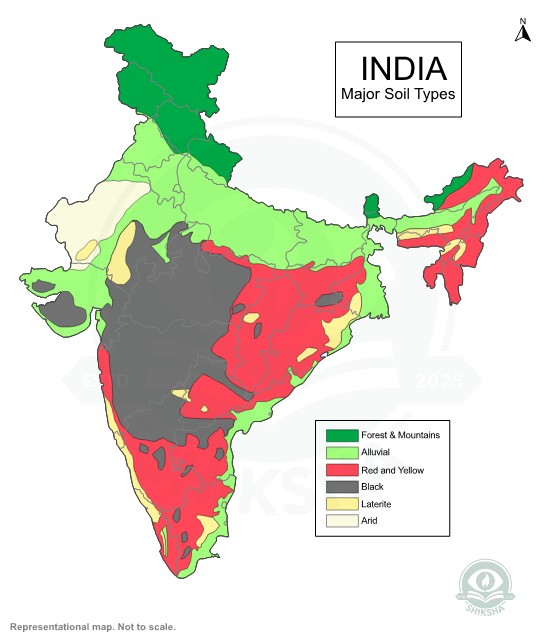
The six major types of soil found in India are: Alluvial Soil, Black Soil, Red and Yellow Soil, Laterite Soil, Forest and Mountain Soil, and Arid/Desert Soil.
Soil Distribution in India
Alluvial
46%
Black
18.5%
Red & Yellow
18.5%
Laterite
6%
Forest/Mountain
5.5%
Arid/Desert
5.5%
Factors Affecting Soil Formation
Parent Rock Material
The underlying rock determines mineral composition, texture, and color. Basalt forms black soil, while granite forms red soil.
Climate
Temperature and rainfall influence soil formation. Heavy rainfall causes leaching, while heat speeds up decomposition.
Topography
Slope and elevation affect drainage and erosion. Plains allow deposition while steep slopes create thin, rocky soils.
Biological Activity
Plants, animals, and microorganisms add organic matter (humus) and break down minerals through decomposition.
Time
Soil formation takes thousands of years. Older soils have well-developed layers while younger soils are less developed.
Six Major Soil Types of India
1. Alluvial Soil
46% Coverage
Most fertile soil in India
Colour
Light grey to ash grey
Texture
Sandy loam to clay
Rich In
Potash, Phosphoric acid, Lime
Deficient In
Nitrogen, Phosphorus
Regions: Indo-Gangetic Plains (Punjab, Haryana, UP, Bihar, West Bengal), Brahmaputra Valley, and coastal deltas of Mahanadi, Godavari, Krishna, and Kaveri rivers.
Formation: Formed by sediments deposited by rivers originating from the Himalayas. These are transported or azonal soils constantly replenished by recurrent floods.
Types: Divided into Khadar (new alluvium on floodplains, extremely fertile) and Bhangar (old alluvium on elevated terraces, contains calcium carbonate nodules called kankar).
Suitable Crops
Rice
Wheat
Sugarcane
Maize
Pulses
Oilseeds
Jute
Cotton
2. Black Soil (Regur)
18.5% Coverage
Also called "Black Cotton Soil"
Colour
Deep black to dark grey
Texture
Clayey, deep, impermeable
Rich In
Iron, Lime, Calcium, Magnesium
Deficient In
Nitrogen, Phosphorus, Organic matter
Regions: Deccan Plateau — Maharashtra, Madhya Pradesh, Gujarat, Andhra Pradesh, Karnataka, and Tamil Nadu. Spread across the Deccan Trap (volcanic basalt region).
Formation: Formed from weathering of volcanic basalt rocks (Deccan Trap). These are in-situ or sedentary soils. The black colour is due to titaniferous magnetite and humus content.
Special Feature: Known as "self-ploughing soil" because it develops wide cracks when dry (shrinks) and swells when wet. Has excellent moisture retention capacity.
Suitable Crops
Cotton
Sugarcane
Wheat
Jowar
Linseed
Sunflower
Millets
Tobacco
3. Red and Yellow Soil
18.5% Coverage
Iron-rich crystalline soil
Colour
Red, yellow, or reddish-brown
Texture
Sandy to clayey, porous
Rich In
Iron oxide, Potash
Deficient In
Nitrogen, Phosphorus, Humus, Lime
Regions: Eastern and Southern parts of the Deccan Plateau — Odisha, Chhattisgarh, southern Ganga Plain, parts of Tamil Nadu, Karnataka, Andhra Pradesh, Madhya Pradesh.
Formation: Formed from crystalline and metamorphic rocks (granite, gneiss) under low rainfall conditions. The red colour is due to iron oxide present in crystalline form. Yellow colour appears in hydrated areas.
Characteristics: Generally low in fertility but responds well to fertilizers and irrigation. Acidic in nature with good drainage.
Suitable Crops
Millets
Groundnut
Pulses
Tobacco
Potatoes
Wheat
Rice
Oilseeds
4. Laterite Soil
~6% Coverage
"Later" = Brick (Latin) | Used for construction
Colour
Reddish-brown to yellowish
Texture
Coarse, porous, gravelly
Rich In
Iron oxide, Aluminium, Bauxite
Deficient In
Nitrogen, Potash, Lime, Organic matter
Regions: Karnataka, Kerala, Tamil Nadu, Madhya Pradesh, hilly areas of Odisha, Assam, Maharashtra (Western Ghats), Eastern Ghats, Vindhyas, Satpuras, Malwa Plateau.
Formation: Formed under tropical conditions of high temperature and heavy rainfall with alternate wet and dry periods. Intense leaching washes away silica and lime, leaving behind iron and aluminium oxides.
Special Feature: Soft when wet (like butter) but hardens like brick when dry. This property makes it excellent for house construction in South India.
Suitable Crops
Cashew
Tea
Coffee
Rubber
Coconut
Arecanut
Tapioca
Rice
5. Forest and Mountain Soil
~5.5% Coverage
Found in hilly and mountainous regions
Colour
Dark brown to black (humus rich)
Texture
Loamy, silty, gravelly
Rich In
Humus, Organic matter
Deficient In
Potash, Phosphorus, Lime
Regions: Himalayan regions (J&K, Himachal Pradesh, Uttarakhand, Sikkim, Arunachal Pradesh), Western and Eastern Ghats, Vindhyas, Satpuras, and Nilgiri Hills.
Formation: Formed from accumulation of organic matter (leaf litter, dead plants) from forest vegetation. Character varies with parent rocks, altitude, and climate. Generally shallow and immature.
Types: Divided into Podzols (mid-altitude, acidic, found in Assam, Darjeeling, Kashmir) and High Altitude Soils (above snowline, very thin, supports alpine meadows).
Suitable Crops
Tea
Coffee
Spices
Apples
Pears
Apricots
Maize
Barley
6. Arid/Desert Soil
~5.5% Coverage
Found in regions with <50cm annual rainfall
Colour
Red to brown (sandy)
Texture
Sandy, porous, saline
Rich In
Phosphate, Calcium
Deficient In
Nitrogen, Humus, Moisture
Regions: Western Rajasthan (Thar Desert), parts of Gujarat, southern Punjab, Haryana, and rain-shadow areas of Karnataka and Telangana.
Formation: Formed in arid and semi-arid regions with very low rainfall. Due to high evaporation and lack of moisture, soil is not well-developed. Contains high salt content.
Special Feature: Contains kankar (calcium carbonate) layer in lower horizons which restricts water infiltration. When irrigated, these soils become productive. Also known as Usara soils.
Suitable Crops
Bajra
Jowar
Barley
Pulses
Guar
Mustard
Wheat*
Cotton*
Quick Comparison Table
| Soil Type | Key Feature | Main Region | Best Crop |
|---|---|---|---|
Alluvial |
Most fertile, river-deposited | Indo-Gangetic Plains | Rice, Wheat |
Black |
Self-ploughing, moisture retention | Deccan Plateau | Cotton |
Red & Yellow |
Iron-rich, acidic | Eastern & Southern India | Millets, Groundnut |
Laterite |
Hardens like brick, leached | Western Ghats, Kerala | Cashew, Tea, Coffee |
Forest/Mountain |
Humus-rich, shallow | Himalayan regions | Tea, Temperate fruits |
Arid/Desert |
Sandy, saline, kankar layer | Rajasthan (Thar Desert) | Bajra, Jowar |
Key Takeaways
Alluvial soil is the most widespread and fertile, covering about 46% of India's land area and supporting most of the population.
Black soil (Regur) is ideal for cotton cultivation due to its excellent moisture retention capacity.
Laterite soil gets its name from Latin "later" meaning brick, as it hardens on exposure to air.
Red soil gets its colour from iron oxide present in crystalline and metamorphic rocks.
Khadar and Bhangar are two types of alluvial soil — new and old alluvium respectively.
Soil degradation affects about 30% of India's land, making soil conservation crucial for sustainable agriculture.
🌱 Knowledge Check
Test Your Understanding
Challenge yourself with questions on India's Soil Types
15
Questions
4
Options Each
0
Your Score
0/15
Great effort! Review the solutions to learn more.
1
Which soil type covers the largest area in India?
Answer: A
Alluvial soil is the most widespread soil type in India, covering approximately 46% of the total land area. It is found mainly in the Indo-Gangetic Plains and river deltas, making it the foundation of India's agricultural wealth.
2
Black soil is also known as:
Answer: C
Black soil is also known as Regur soil or "Black Cotton Soil" because it is ideal for cotton cultivation. Khadar and Bhangar are types of alluvial soil, while Usara refers to saline/alkaline soils.
3
The word "Laterite" is derived from Latin word "Later" which means:
Answer: B
The word "Laterite" comes from the Latin word "Later" meaning brick. This is because laterite soil is soft when wet but hardens like brick when dry, making it excellent for construction purposes in South India.
4
Which soil is called "self-ploughing soil"?
Answer: D
Black soil is called "self-ploughing soil" because it develops wide cracks when dry (shrinks) and swells when wet. This constant expansion and contraction naturally aerates the soil, similar to ploughing.
5
Khadar and Bhangar are types of which soil?
Answer: A
Khadar (new alluvium on floodplains) and Bhangar (old alluvium on elevated terraces) are two types of alluvial soil. Khadar is more fertile and gets replenished by annual floods, while Bhangar contains calcium carbonate nodules called kankar.
6
Red soil gets its colour from:
Answer: C
Red soil gets its characteristic reddish colour from iron oxide present in crystalline and metamorphic rocks like granite and gneiss. When iron oxide is in hydrated form (waterlogged areas), the soil appears yellowish.
7
Which soil is most suitable for cotton cultivation?
Answer: B
Black soil is most suitable for cotton cultivation, which is why it's also called "Black Cotton Soil." Its excellent moisture retention capacity allows cotton to grow even without much irrigation.
8
Black soil is mainly found in which region of India?
Answer: D
Black soil is primarily found in the Deccan Plateau region, spread across Maharashtra, Madhya Pradesh, Gujarat, Andhra Pradesh, Karnataka, and Tamil Nadu. It's formed from the weathering of volcanic basalt rocks (Deccan Trap).
9
Which process causes laterite soil to lose its fertility?
Answer: A
Leaching is the process where heavy rainfall washes away essential nutrients like silica, lime, and potash from the soil, leaving behind iron and aluminium oxides. This makes laterite soil poor in fertility but rich in bauxite.
10
Cashew nuts are best grown in which type of soil?
Answer: C
Laterite soil is well-suited for tree crops like cashew nuts, tea, coffee, rubber, and coconut. Red laterite soil in Kerala, Tamil Nadu, and Andhra Pradesh is particularly famous for cashew cultivation.
11
Which soil contains "kankar" (calcium carbonate nodules) in its lower layers?
Answer: B
Bhangar (old alluvial soil) and Desert/Arid soil both contain kankar (calcium carbonate nodules) in their lower horizons. In desert soils, this kankar layer restricts water infiltration.
12
Forest and mountain soils are rich in:
Answer: D
Forest and mountain soils are rich in humus (organic matter) derived from decomposed leaf litter and dead vegetation. However, they are deficient in potash, phosphorus, and lime.
13
Alluvial soils are deficient in which nutrient?
Answer: A
Alluvial soils are generally deficient in nitrogen and phosphorus, while they are rich in potash, phosphoric acid, and lime. This is why nitrogen-based fertilizers are commonly used in alluvial regions.
14
Which type of soil is formed from volcanic basalt rocks?
Answer: C
Black soil is formed from the weathering of volcanic basalt rocks of the Deccan Trap. The black colour comes from titaniferous magnetite and humus content in the soil.
15
Desert/Arid soil is found mainly in which state of India?
Answer: B
Desert/Arid soil is mainly found in Rajasthan (Thar Desert region), along with parts of Gujarat, southern Punjab, and Haryana. These soils are sandy, saline, and poor in organic matter but become productive when irrigated.
Tags:
6 soil types in indiaagriculture in indiaalluvial soil in indiablack soil regur soilcompetitive exam geographycrops and soils in indiadesert soil in indiaforest soil in indiaindian agriculture soilsIndian Geographyindian geography noteslaterite soil in indiamajor soil types in indiared soil in indiasoil distribution in indiasoil types in indiasoils of india mapssc geography notesstatic gk indiaupsc geography notes